Seesii Spot Welders Compared: Which Model Suits Your Battery or Metal Work?
Specs below are quoted from each Amazon listing. Scores are out of 10, based on listed specifications and buyer feedback. Nothing on this page was handled or measured by us.
As Amazon Associates, we earn from qualifying purchases. This means we may receive a small commission at no extra cost to you if you click through and make a purchase.
Finding the right seesii spot welder comes down to matching the machine to the specific metals and thicknesses you intend to join. While Seesii made its name among hobbyists for compact battery pack welders, the brand’s catalog actually covers two completely different welding categories: low-voltage resistance welders designed for delicate battery assembly, and high-amperage arc machines built for structural steel fabrication. If your primary goal is rebuilding cordless power tool batteries, drone packs, or electric bike modules using nickel strip, a battery spot welder delivers clean resistance pulses that fuse metal tabs without transferring excessive heat to sensitive lithium cells. On the other hand, if you need to mend farm equipment, car panels, or iron gates, choosing an arc or flux-core welder is required to generate the penetration necessary for thick steel.
This comprehensive comparison reviews five distinct Seesii welders to help you make an informed choice for your workshop. The lineup includes two portable cordless battery spot welders optimized for 18650 cells, a heavy-duty benchtop capacitive discharge spot welder designed for thicker pure nickel sheets, a multi-process gasless flux-core MIG machine, and a complete handheld stick welding kit with a darkening helmet. By breaking down power outputs, material limitations, gear settings, and practical use cases, this guide clarifies where each model excels and where it reaches its operating ceiling.
Which Seesii Spot Welders Should You Buy
- For mobile battery maintenance and small DIY pack repairs requiring a durable metal enclosure, choose the SEESII Battery Spot Welder (model SE209).
see 1 of 5 - For cable-free cylindrical cell builds where you want the welding pens integrated directly into the handheld unit, choose the SEESII Battery Spot Welder (model SE302).
see 1 of 5 - For high-volume workshops and thick pure nickel tabs up to 0.3mm that require high peak energy, choose the SEESII Capacitive Battery Spot Welder.
see 3 of 5 - For garage fabrication, outdoor structural steel, and farm repairs needing gasless flux core or stick capability, choose the SEESII 135A MIG Welder 110V.
see 4 of 5 - For quick outdoor iron fixes and beginners who want a complete handheld arc setup with eye protection included, choose the Seesii Portable Welder 110V with Auto.
see 5 of 5
SEESII Battery Spot Welder

Affiliate link. Price and stock live at Amazon and change there, not on this page.
Best for
Cable-free cylindrical cell battery pack assembly
Pros
- Fully cordless integrated pens
- 99 fine-tuning power levels
- Auto and manual trigger modes
Cons
- Weld quality drops as battery drains

Best for
Light battery pack repair on the go
Pros
- Rugged aluminum casing
- Overheat cutoff above 65C
- 80 adjustable power gears
Cons
- Limited to 0.15mm pure nickel
The SEESII Battery Spot Welder, designated under manufacturer part number SE209, is an ultra-portable resistance welder built specifically for custom battery maintenance and pack fabrication. Delivering up to 3300 watts of output power from its internal rechargeable battery, this cordless device frees builders from restrictive wall cords. It is designed to handle nickel-plated steel strips up to 0.2mm thick and pure nickel sheets up to 0.15mm, making it a capable companion for fixing power tool packs, assembling drone batteries, and maintaining small electric vehicle battery modules.
Operating control is centered around an integrated visual display screen that provides real-time readouts of voltage, active gear settings, and welding modes. With 80 adjustable power gears, users can dial in the precise pulse duration required for different strip gauges, avoiding weak tack welds on the lower end or dangerous cell burn-through on the higher end. The device features an automatic overheat protection mechanism that halts operation if internal temperatures exceed 65 degrees Celsius, protecting the internal lithium cells during extended work sessions. The rugged aluminum shell adds impact resistance, while the included tip file and sandpaper help maintain clean copper contacts.
This unit is best suited for hobbyists and DIYers needing a reliable seesii portable spot welder for 18650 battery packs who prefer working with independent welding leads. It excels at intermittent maintenance and small custom builds. However, if your work demands rapid continuous welding on heavier pure nickel busbars exceeding 0.15mm, this handheld unit gives way to Seesii’s higher-output capacitive bench equipment.
- 80 refined power regulation gears with a visual screen showing voltage and active mode
- Welding capacity reaching 0.2mm on nickel-plated strip and 0.15mm on pure nickel
- Overheat safety cutoff that automatically halts welding when internal heat passes 65 degrees Celsius
- Includes aluminum body welder, two five-meter nickel-plated rolls, cleaning file, sandpaper, and charging cable
SEESII Battery Spot Welder
Taking portable battery assembly in a more integrated direction, the SEESII Battery Spot Welder (model SE302) eliminates the flexible cable leads found on traditional units. Instead, it incorporates two replaceable welding pens directly onto the head of the handheld body. This fully cordless design weighs just 14.4 ounces and allows builders to manipulate the welding electrodes with one hand, streamlining repetitive welds across rows of cylindrical cells. A protective pen cover prevents accidental contact when the tool is stowed in a mobile kit.
Internally, the SE302 draws on a dedicated NiMH power source delivering up to 3360 watts of output power across 99 fine-adjustment gears. Like its sibling, it is tested to bond nickel-plated sheets up to 0.2mm and pure nickel strips up to 0.15mm, though weld penetration remains closely tied to remaining battery charge. Users can toggle freely between automatic contact triggering and manual pulse modes, while an intuitive digital display monitors real-time welding status, internal temperature, and battery percentage. The welding pens can be unscrewed directly with tweezers whenever the copper tips require maintenance or replacement.
This design is ideal for enthusiasts engaged in small battery pack DIY who prioritize seamless portability, such as repairing cordless vacuums, re-tabbing phone batteries, or assembling button-cell arrays. Because optimal performance depends directly on battery state of charge, the manufacturer advises charging the device to 100 percent before first use and topping it off monthly during storage. Users requiring heavy production capacity or thicker metal strips will find the corded capacitive model better suited to high-volume assembly.
- Integrated handheld form factor without dragging electrode cables across your workbench
- 99 adjustable gear levels with support for both automatic triggering and manual pulse modes
- Output reaching 3360 watts for welding pure nickel up to 0.15mm and nickel-plated sheets up to 0.2mm
- Low standby power consumption and easily removable screw-in welding pins
SEESII Capacitive Battery Spot Welder

Affiliate link. Price and stock live at Amazon and change there, not on this page.
SEESII 135A MIG Welder 110V

Affiliate link. Price and stock live at Amazon and change there, not on this page.
Seesii Portable Welder 110V with Auto
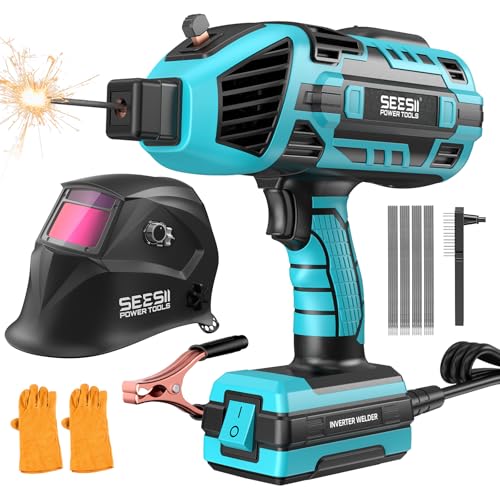
Affiliate link. Price and stock live at Amazon and change there, not on this page.
What Sets These Models Apart
Choosing between these five Seesii welders requires looking closely at power supply architecture, operating amperage, and the specific materials each tool is engineered to join. The cordless units deliver localized micro-resistance pulses for heat-sensitive electronics, the capacitive bench machine generates high-energy micro-welds for heavy battery busbars, and the 110V arc welders generate sustained plasma arcs for melting structural steel. The following table summarizes the core technical differences across the lineup.
| Model | Process and Intended Use | Power Source and Rating | Material Capacity |
|---|---|---|---|
| SEESII Battery Spot Welder (SE209) | Micro-resistance spot welding for small battery packs | Rechargeable battery (3300W output, cordless) | 0.2mm nickel-plated steel, 0.15mm pure nickel |
| SEESII Battery Spot Welder (SE302) | Cable-free handheld resistance spot welding | Rechargeable NiMH battery (3360W output) | 0.2mm nickel-plated steel, 0.15mm pure nickel |
| SEESII Capacitive Battery Spot Welder (SE-305-2608) | Capacitive discharge bench spot welding | 110V AC corded (10KW peak, 2000A current) | 0.4mm nickel-plated steel, 0.3mm pure nickel |
| SEESII 135A MIG Welder 110V (MIG-135) | Gasless flux-core MIG, MMA stick, Lift TIG | 110V AC corded (30A-135A IGBT inverter) | Up to 5/16-inch mild steel plate |
| Seesii Portable Welder 110V with Auto (FA209) | Handheld MMA stick arc welding kit | 110V AC corded (20A-120A IGBT inverter) | 3/64-inch to 1/8-inch welding rods on steel |
Figures in this table are copied from the Amazon listings for these models.
Buying Tips for Seesii Spot Welders
When selecting a welder for battery fabrication, material composition dictates your power requirements. Pure nickel strip is universally preferred for high-draw battery packs because of its low electrical resistance and excellent corrosion resistance. However, pure nickel conducts electricity and dissipates heat far more readily than nickel-plated steel. While a portable cordless unit handles 0.15mm pure nickel with ease, running thicker 0.2mm or 0.3mm pure nickel strips requires the substantial current reserves found only in capacitive discharge machines like the SE-305-2608. Always verify whether your project uses pure nickel or nickel-plated steel before matching it to your welder’s gear range. Keep in mind that neither style of resistance welder is recommended for aluminum or copper strips, as both metals exhibit thermal conductivity too high for standard micro-spot welders to fuse reliably.
Workshop organization and maintenance also play a massive role in achieving repeatable welds. Clean copper electrode tips are mandatory for spot welding; carbon deposits and oxidation will increase contact resistance, causing weak welds or surface sparks that damage cell casings. Use the included cleaning file and abrasive paper regularly to maintain smooth, dome-shaped tips on your welding pens. When setting up your workshop for mixed fabrication tasks—whether repairing cracked plastic battery housings with a wrdlosy plastic staples welding portable kit or joining heavy steel brackets—matching the tool to the substrate is essential.
Finally, always respect the operational limits of cordless spot welders. The discharge power of battery-powered units drops noticeably as the internal cell discharges below 50 percent capacity, which can lead to inconsistent weld strength across a large battery build. Keep cordless models charged, and avoid continuous rapid-firing that pushes the unit past its 65-degree thermal cutoff. For long-term battery health, make sure to top off stored spot welders at least once a month so the internal lithium or NiMH cells do not fall into deep discharge.
FAQ
Can a Seesii spot welder weld pure nickel strips?
Yes, but the maximum thickness depends on the model. The portable battery-powered SE209 and SE302 models can reliably weld pure nickel strips up to 0.15mm thick. If you need to weld thicker 0.2mm or 0.3mm pure nickel strips for high-current applications, you must use the Seesii Capacitive Battery Spot Welder, which delivers 10KW of peak power and 2000A of peak current.
What is the difference between cordless battery spot welders and capacitive bench units?
Cordless battery spot welders rely on internal rechargeable cells to deliver compact energy bursts, making them lightweight, highly mobile, and ideal for quick repairs. Capacitive bench spot welders plug into standard 110-volt AC power and store massive electrical charges within specialized capacitors. This allows capacitive units to deliver vastly higher peak amperage, maintain consistent power without battery voltage sag, and weld thicker materials without overheating.
Can Seesii welders join copper or aluminum battery terminals?
No. Seesii explicitly advises against attempting to weld pure copper or aluminum tabs with their battery spot welders. Both copper and aluminum feature extremely high thermal and electrical conductivity, which prevents standard resistance spot welders from generating the concentrated localized heat required to melt and fuse the metals together.
How often should you dress or clean Seesii spot welder tips?
You should inspect and clean the copper welding tips whenever you notice dark carbon buildup, pitting, or reduced weld penetration. Carbon deposits dramatically raise contact resistance, which leads to surface sparking and weak joints. Lightly dressing the tips using the included cleaning file or fine-grit sandpaper restores clean metal contact and extends tip longevity.
Can the Seesii 135A MIG welder be used for battery pack assembly?
No. The Seesii 135A MIG welder is an arc welding machine designed for joining structural steel, iron, and sheet metal up to 5/16 inch thick. Attempting to use a flux-core, stick, or TIG arc machine on delicate battery cells would immediately burn through the metal casing and rupture the lithium cell, posing severe safety and fire hazards.


