Reolink 360° PoE Cameras: Which Full-Coverage Model Fits Your Space?
6 models comparedSeptember 22, 202614 min read
Specs below are quoted from each Amazon listing. Scores are the average rating Amazon buyers left. Nothing on this page was handled or measured by us.
As Amazon Associates, we earn from qualifying purchases. This means we may receive a small commission at no extra cost to you if you click through and make a purchase.
When shopping for a reolink 360 poe security setup, finding true full-coverage monitoring depends entirely on how the camera captures your surroundings. While shoppers often expect every camera labeled with panoramic or panoramic-style capabilities to operate identically, Reolink actually delivers comprehensive surveillance through three distinct optical designs. One approach relies on a stationary 360-degree fisheye lens that takes in an entire room at once from an overhead mount, another uses motorized pan-and-tilt mechanics to physically sweep across a full circle outdoors, and a third combines dual or triple lenses to stitch an ultra-wide panoramic overview while tracking moving subjects. Choosing between these formats determines whether you get instant, uninterrupted perimeter awareness or targeted, long-range zoom clarity.
This comparison covers exactly 6 Reolink PoE cameras that provide complete room coverage, motorized rotation, or expansive multi-lens fields of view. Across these six options, you will find dedicated 6MP ceiling fisheyes engineered for retail and indoor spaces, heavy-duty outdoor PTZ domes with long-distance optical magnification, and multi-lens platforms designed to guard large acreage. By breaking down how each camera captures movement, processes high-resolution video streams, and pulls data and power over a single network line, this guide will help you determine which reolink 360 poe camera configuration fits your specific layout.
Which Reolink 360° PoE Security Cameras Should You Buy
Selecting the right surveillance model comes down to matching your mounting location, desired viewing angle, and need for mechanical movement. Here is how each model aligns with specific monitoring environments:
Open retail floors, indoor showrooms, and central office ceilings: REOLINK 6MP 360° Fisheye Security Camera see 1 of 6
Single-room indoor monitoring without an existing PoE switch: REOLINK PoE IP Fisheye Camera Bundle see 2 of 6
Expansive outdoor yards, pastures, and commercial lots requiring extreme zoom: REOLINK RLC-823S2 4K 16X Optical Zoom see 3 of 6
Residential driveways and entryways needing simultaneous wide-angle and close-up views: REOLINK TrackMix PoE Grey Dual-Lens PTZ see 4 of 6
Wide commercial boundaries and large parking areas requiring seamless tracking: REOLINK OMVI 3i PoE Triple-Lens PoE see 5 of 6
Vandal-prone exterior walls, low overhangs, and garages: REOLINK Duo 2V PoE 8MP Dual-Lens see 6 of 6
Affiliate link. Price and stock live at Amazon and change there, not on this page.
Best for Indoor spaces needing complete ceiling coverage
Pros
Full 360-degree panoramic 6MP view
Fisheye dewarping software support
Two-way talk on PoE model
Cons
Indoor installation only
WiFi unit requires separate power
The REOLINK 6MP 360° Fisheye Security Camera package is engineered specifically for complete indoor visibility without mechanical blind spots. Rather than physically rotating a lens across a room, this camera captures an unbroken, circular panoramic field of view using a 6MP high-resolution sensor. When mounted dead-center on a ceiling, it records every corner of a retail shop, office space, warehouse aisle, or conference room simultaneously, ensuring that no activity occurs outside the frame.
Because raw circular fisheye footage can be difficult to interpret, the camera relies on software-based dewarping technology. This feature allows viewers to flatten the panoramic feed into natural, rectangular perspectives, quad-split views, or simulated pan-tilt-zoom modes right within the monitoring software. This specific bundle includes both a PoE fisheye camera for direct single-cable wiring and a dual-band wireless fisheye companion, providing an adaptable multi-room deployment option.
On the hardware side, the PoE unit supports responsive two-way audio communication, allowing operators to speak directly with visitors or staff. Built-in smart human detection filters video feeds to deliver instant mobile alerts only when a person enters the area, drastically reducing false notifications from light shifts or HVAC movement. Footage can be captured locally onto an onboard microSD card up to 512GB or continuously fed into a network video recorder without ongoing subscription requirements.
Affiliate link. Price and stock live at Amazon and change there, not on this page.
Best for Offices without existing PoE network switches
Pros
Includes dedicated gigabit PoE injector
Undistorted dewarped 6MP video
Supports Amazon Alexa voice integration
Cons
Not weatherproof for outdoor use
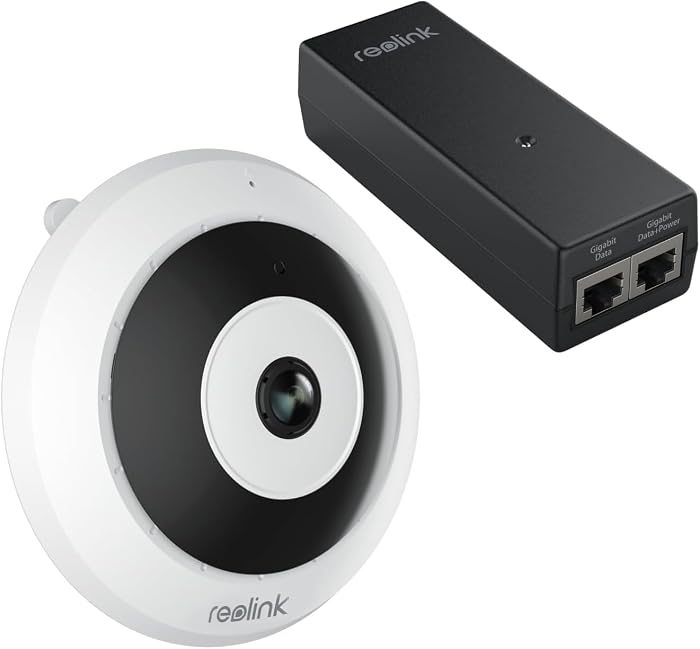
For installations where an existing Power over Ethernet network infrastructure is not already in place, the REOLINK PoE IP Fisheye Camera Bundle delivers an all-in-one setup right out of the box. This package pairs Reolink’s 6MP white indoor fisheye camera with a dedicated Gigabit PoE injector, allowing homeowners and small business managers to convert standard wall outlets and basic router ports into an enterprise-style, single-cable power and data pipeline.
The included Gigabit injector is engineered to supply PoE (15.4W) or PoE+ (30W) power over Ethernet runs stretching up to 100 meters, making it straightforward to position the camera on high ceilings or remote hallway walls. This dedicated reolink fisheye poe camera solution captures vivid 6MP high-definition video in MPEG-4 format, completely covering the perimeter without requiring multiple individual cameras aimed in opposite directions.
Users can take advantage of multiple panoramic viewing methods and image dewarping to turn the circular camera perspective into flat, easy-to-read room sectors. The unit is optimized for wall or ceiling mounting within offices and indoor living spaces, offering compatibility with Amazon Alexa voice assistants. Like other standalone Reolink units, it manages continuous and event-based video without recurring monthly service fees.
Bundled Reolink Gigabit PoE injector supporting cable runs up to 100 meters
6MP ultra-wide fisheye optical array designed to replace multi-camera indoor arrays
Fisheye dewarping software to create undistorted, rectangular display views
Compatible with Amazon Alexa smart home displays and standard Ethernet connections
Affiliate link. Price and stock live at Amazon and change there, not on this page.
Best for Large acreage and long-distance perimeter monitoring
Pros
Full 360-degree pan and 90-degree tilt
Powerful 16X optical zoom
Stunning 4K resolution with spotlights
Cons
Requires IEEE 802.3at PoE+ power
Does not support WiFi
When monitoring wide-open outdoor terrain, a static fisheye lens lacks the reach needed to identify distant objects, which is where the REOLINK RLC-823S2 4K 16X Optical Zoom takes over. This heavy-duty motorized outdoor PTZ unit is built for massive coverage, providing an endless 360-degree pan and 90-degree tilt capability. Paired with an extraordinary 16X optical zoom mechanism, it allows operators to inspect vehicles, gate access points, and fence perimeters located hundreds of feet away without sacrificing pixel clarity.
Driving this expansive movement is an intelligent auto-tracking system that detects movement and follows subjects across the property automatically. To make manual tracking equally effortless, the integrated 3D zoom function enables users to click on any point of interest on screen, instantly centering and zooming the motorized glass onto the target. Operating as a heavy-duty reolink 360 outdoor camera, it features a rugged IP66-rated waterproof enclosure and uses an IEEE 802.3at PoE+ connection to run the motors, sensor, and integrated spotlights over a single network line.
Surveillance clarity remains crisp around the clock thanks to 4K 8MP video capture. During night operations, the camera can switch between traditional infrared illumination and vivid full-color night vision driven by powerful spotlights. Advanced onboard AI processes person, vehicle, and animal movements directly on the camera hardware, reducing unnecessary alerts and powering crisp two-way audio interactions.
Continuous 360-degree motorized panning and 90-degree tilt with intelligent auto-tracking
High-powered 16X optical zoom with one-click 3D zoom screen centering
Ultra HD 4K 8MP video resolution supported by color and infrared night vision modes
Weatherproof IP66 metal construction engineered for demanding exterior environments
Affiliate link. Price and stock live at Amazon and change there, not on this page.
Best for Driveways needing overview and zoom tracking
Pros
Dual view on one screen
Automatic tracking with 6X hybrid zoom
Built-in spotlights and sirens
Cons
MicroSD card sold separately
The REOLINK TrackMix PoE Grey Dual-Lens PTZ solves the primary limitation of traditional single-lens rotating cameras: losing sight of the overall scene while zooming in. By deploying two synchronized lenses within a single motorized head—a wide-angle 2.8mm lens and an 8mm telephoto lens—the camera outputs a dual-view stream onto a single monitoring screen. This allows you to maintain full situational context on the wide-angle feed while viewing a magnified, close-up feed of an active subject.
During security events, the camera utilizes an auto-tracking mechanism driven by 6X hybrid zoom. As the wide-angle camera identifies a person, vehicle, or pet moving across the property, the motorized mechanism pans and tilts to follow the subject while the telephoto lens automatically punches in with a detailed 4K or 2MP close-up. This setup provides exceptional evidence gathering for residential driveways and commercial entrance gates looking for a high-performing reolink 4k poe security camera option.
Housed in a modern grey chassis with a ceiling mount design, the TrackMix PoE combines active deterrence with effortless connectivity. Motion detection instantly triggers bright spotlights and a warning siren to deter trespassers, while push and email alerts inform the owner in real time. Video feeds can be backed up directly to an internal microSD card up to 512GB, an on-site Reolink NVR, or an offsite FTP server.
Dual-lens architecture providing simultaneous wide-angle overview and telephoto tracking on one screen
6X hybrid zoom with responsive auto-tracking for individuals, vehicles, and pets
Active deterrence system featuring motion-activated spotlights, sirens, and two-way talk
Single-cable PoE connection in a ceiling-mount grey housing with local storage up to 512GB
Affiliate link. Price and stock live at Amazon and change there, not on this page.
Best for Expansive commercial lots and wide perimeters
Pros
Triple-lens 18MP total resolution
SyncTrack locks target across screens
Rugged IP66 weatherproof metal housing
Cons
Requires updated NVR firmware
Does not support WiFi connection
For expansive commercial facilities, industrial parking lots, and long driveways, the REOLINK OMVI 3i PoE Triple-Lens PoE represents the pinnacle of multi-sensor coverage. This powerhouse incorporates three individual camera modules into a single heavy-duty metal housing, delivering an astonishing combined resolution of 18MP. The system pairs a 10MP dual-lens panoramic array that maintains an unbroken 180-degree fixed overview with a motorized 8MP pan-tilt camera positioned right beneath it.
The flagship capability of this unit is SyncTrack technology. When an intruder or vehicle enters the 180-degree panoramic field, the static sensor immediately coordinates with the lower PT camera, instructing it to lock onto the target, zoom in, and follow its movement across the property. This dual-screen surveillance experience guarantees that you never lose the broader operational picture, even if a moving target maneuvers beyond the primary zoom frame, making it an exceptional reolink outdoor camera for mission-critical perimeters.
Beyond optical tracking, the OMVI 3i offers enterprise-grade perimeter security tools. Administrators can establish customized virtual fences, tripwires, and intrusion zones to trigger automated deterrent lights and audible alarms before threats reach a building. The unit features IP66 weatherproofing, H.265 compression, full-color night vision, and support for 24/7 continuous recording across microSD cards, Reolink NVRs, NAS systems, and FTP servers.
Total 18MP triple-lens array combining a 10MP 180-degree panoramic view with an 8MP PT tracker
SyncTrack system that detects targets on the panoramic sensor and tracks them via the PT lens
Customizable perimeter protection features including virtual fences and intrusion alert zones
Rugged IP66-rated metal enclosure designed for wide commercial yards and parking facilities
Affiliate link. Price and stock live at Amazon and change there, not on this page.
Best for Vandal-prone exterior walls and low eaves
Pros
IK10 vandal-proof aluminum construction
Seamless 180-degree panoramic view
F1.6 aperture for low-light clarity
Cons
No motorized pan or tilt control
PoE injector not included
Unlike motorized PTZ units that rely on internal gears to rotate their lenses, the REOLINK Duo 2V PoE 8MP Dual-Lens achieves massive horizontal visibility using image stitching. By placing two precision lenses side by side inside a protective dome, this camera merges two video feeds into a seamless, distortion-free 180-degree panoramic stream at crisp 8MP resolution. It effectively delivers the visual coverage of two standard security cameras over a single network drop.
Durability is the standout attribute of this model. The Duo 2V features an IK10 vandal-proof rating backed by a solid aluminum dome shell, allowing it to withstand physical impacts, vandalism, and direct strikes from equipment. This makes it the premier choice for low-clearance building eaves, exterior garage walls, loading bays, and public alleyways where physical tampering is a legitimate risk.
While the internal camera mechanism does not offer software-controlled motorized panning or tilting, it features a built-in manual rotation bracket that allows technicians to dial in the perfect viewing angle during initial installation. Night performance is bolstered by an ultra-wide F1.6 aperture, customizable motion-triggered spotlights, and infrared night vision. The camera also supports smart detection for people, vehicles, and animals, alongside two-way audio and versatile local storage options.
Dual-lens image stitching providing a seamless 180-degree panoramic field of view in 8MP clarity
IK10 vandal-proof impact rating with heavy-duty aluminum dome enclosure
Bright F1.6 aperture lens paired with customizable color night vision spotlights
On-camera artificial intelligence detecting people, vehicles, and animals without cloud fees
What Sets These Models Apart
Understanding the fundamental engineering differences between these models ensures you select the correct hardware for your property layout. A thorough reolink poe camera comparison reveals that coverage style plays a much larger role in daily usability than raw megapixels alone. The indoor fisheye models capture light in a 360-degree hemisphere, relying on digital dewarping to split one panoramic bubble into manageable flat views. While this offers total indoor visibility with zero moving parts, it lacks the optical reach needed for outdoor perimeter defense.
In contrast, Reolink’s outdoor cameras divide into motorized pan-tilt tracking and multi-lens fixed panoramic stitching. Models like the RLC-823S2 and TrackMix PoE use physical gear assemblies to rotate across 360 degrees or track moving subjects with telephoto glass. Multi-lens units like the Duo 2V and OMVI 3i stitch adjacent visual streams together to eliminate horizontal blind spots without needing to rotate at all. The table below outlines how each unit delivers coverage across different environments.
Model
Coverage Mechanism
Resolution
Primary Installation Setting
REOLINK 6MP 360° Fisheye Security Camera
Single Fisheye Lens (360° View)
6MP
Indoor retail, open offices, and central ceilings
REOLINK PoE IP Fisheye Camera Bundle
Single Fisheye Lens + PoE Injector
6MP
Indoor rooms without existing PoE networking
REOLINK RLC-823S2 4K 16X Optical Zoom
Motorized PTZ (360° Pan, 90° Tilt)
4K (8MP)
Expansive acreage, long perimeters, and open yards
REOLINK TrackMix PoE Grey Dual-Lens PTZ
Dual-Lens PTZ (Wide-Angle + Telephoto)
4K / 2MP
Driveways, entrance gates, and home exteriors
REOLINK OMVI 3i PoE Triple-Lens PoE
Triple-Lens (180° Panoramic + PTZ)
18MP Combined (10MP + 8MP)
Commercial lots, industrial sites, and long driveways
REOLINK Duo 2V PoE 8MP Dual-Lens
Fixed Dual-Lens Stitched (180° View)
8MP
Vandal-prone exterior walls, garages, and low eaves
Figures in this table are copied from the Amazon listings for these models.
Buying Tips for Reolink 360° PoE Security Cameras
When deciding which reolink 360 camera to buy, start by evaluating your mounting surface and field of view requirements. A 360-degree fisheye camera performs at its best when mounted flat against a high ceiling in the center of an unobstructed room; mounting a fisheye on an exterior wall severely limits its effectiveness because half of the circular view will simply record the wall itself. Conversely, if your goal is monitoring an outdoor fenceline or property border, a 180-degree stitched dual-lens or a motorized PTZ unit will deliver far superior detail at realistic distances.
Power delivery is another crucial consideration when designing a PoE surveillance system. Standard fixed PoE cameras and indoor fisheye models generally draw modest wattage that standard IEEE 802.3af switches can easily provide. However, large motorized cameras like the RLC-823S2 feature internal drive motors, high-intensity night spotlights, and optical zoom assemblies that perform best when paired with an IEEE 802.3at PoE+ power supply. Make sure your network switch or PoE injector matches the power class required by your chosen model to prevent unexpected reboots during nighttime panning operations.
Finally, check your recording infrastructure and client software versions before finalizing your setup. High-end multi-sensor cameras like the OMVI 3i and Duo 2V transmit multiple ultra-high-definition video feeds across a single connection, which requires compatible Network Video Recorder firmware to render correctly on local monitor screens. Updating your Reolink NVR firmware to the latest release ensures you can access dual-screen tracking modes, custom intrusion fences, and full dewarping tools without encountering interface compatibility bottlenecks.
FAQ
Does a Reolink fisheye PoE camera record in a circle or a flat image?
A Reolink fisheye camera natively captures a circular 360-degree image on its image sensor. However, the camera and the companion Reolink software incorporate dewarping algorithms that translate that circular recording into flat, rectangular views, quad-screen panels, or interactive panoramic feeds for easy monitoring and playback.
Can a Reolink PTZ camera watch the entire 360-degree area at the exact same time?
No, a motorized pan-tilt camera can only point its lens in one direction at any given second. While it can rotate 360 degrees to scan an entire property or follow a detected subject, it cannot physically record what is happening behind its lens orientation. If continuous, uninterrupted situational awareness across a full hemisphere is necessary, a stationary fisheye or panoramic multi-lens camera is the preferred choice.
What type of Ethernet cable do Reolink 360 PoE cameras require?
All Reolink PoE cameras operate over standard Cat5e, Cat6, or higher Ethernet cabling. A single network cable carries both electrical power and high-definition video data back to your PoE switch, PoE injector, or Reolink NVR across distances up to 100 meters without requiring local electrical outlets at the camera site.
Do Reolink 360 degree security cameras require a monthly subscription fee?
No, Reolink PoE security cameras do not require monthly subscription plans to access their full suite of features. Smart person, vehicle, and animal detection, automated tracking, two-way audio, and remote app viewing function entirely free of recurring costs, with video recorded locally onto internal microSD cards, Reolink NVR hard drives, or network storage servers.
What is the difference between a multi-lens panoramic camera and a rotating PTZ camera?
A multi-lens panoramic camera uses two or more fixed lenses to capture an expansive 180-degree field of view simultaneously with no moving parts to wear out over time. A rotating PTZ camera uses a single primary lens attached to motorized gears that physically sweep across the scene and zoom in on distant objects, offering superior optical reach at the cost of narrower instantaneous viewing angles.