Renogy Lithium Batteries: Which 12V Model Fits Your Setup?
6 models comparedSeptember 22, 202612 min read
Specs below are quoted from each Amazon listing. Scores are the average rating Amazon buyers left. Nothing on this page was handled or measured by us.
As Amazon Associates, we earn from qualifying purchases. This means we may receive a small commission at no extra cost to you if you click through and make a purchase.
Choosing the right renogy lithium battery requires balancing usable amp-hour capacity, continuous discharge limits, and the physical space inside your vehicle, vessel, or off-grid cabin. Renogy manufactures deep cycle power storage using advanced lithium iron phosphate (LiFePO4) cells as well as traditional absorbent glass mat (AGM) chemistry. While lithium provides superior energy density, rapid recharge speeds, and thousands of discharge cycles, understanding your specific power demands ensures you select the proper configuration without overspending on unused capacity.
This comparison examines 6 distinct Renogy 12V deep cycle batteries, spanning compact drop-in LiFePO4 packs, high-output marine options, large off-grid storage units, and reliable sealed lead-acid alternatives. These models differ across critical engineering boundaries including continuous Battery Management System (BMS) output, integrated low-temperature cut-off mechanisms, water ingress ratings, and remote connectivity protocols.
Which Renogy Lithium Batteries Should You Buy
Compact camper builds and tight drop-in trays: Renogy 100Ah LiFePO4 Lithium Battery see 1 of 6
Standard RV house banks running moderate inverters: Renogy 12V 200Ah LiFePO4 Lithium Battery see 2 of 6
High-demand off-grid cabins and multi-day solar storage: Renogy 12V 300Ah LiFePO4 Lithium Battery see 3 of 6
Sub-freezing off-grid setups requiring simple lead-acid chemistry: Renogy 12 Volt 200Ah Deep Cycle see 4 of 6
Wet marine environments and high-draw electric trolling motors: Renogy 12V 100Ah LiFePO4 Lithium Battery see 5 of 6
Basic off-grid backup and entry-level domestic appliances: Renogy 12 Volt 100Ah Deep Cycle see 6 of 6
Affiliate link. Price and stock live at Amazon and change there, not on this page.
Best for Space-constrained RVs and tight battery trays
Pros
Group 22NF mini footprint
UL-listed prismatic cells
IP65 water resistance
Cons
100A continuous discharge cap
Requires optional shunt for app
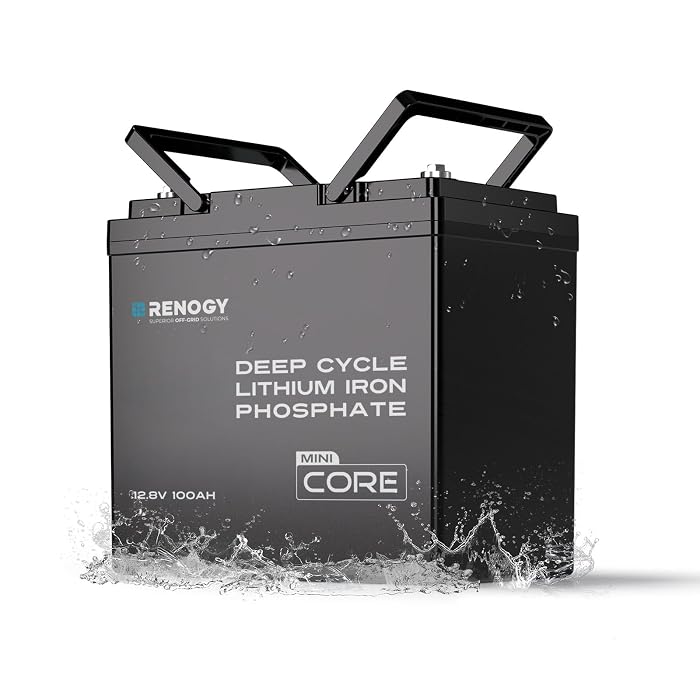
The Renogy 100Ah LiFePO4 Lithium Battery represents the brand’s Core Mini footprint, engineered to fit cramped installations where conventional Group 31 batteries cannot go. Measuring 9.02 by 5.43 by 8.39 inches, this Group 22NF form factor is up to 50 percent smaller than standard Group 31 batteries and weighs only 22.7 pounds. The listing specifies that internal metallic cell spacers hold the UL-listed, EV-grade prismatic cells firmly in place, preventing structural stress or short circuits during off-road travel or rough marine transit.
Safety is managed through an integrated 100A BMS that provides autonomous protection against high temperatures, low-temperature charging conditions, overvoltage, undervoltage, overcurrent, and short circuits. It can be installed in nearly any physical orientation, although the manufacturer states that tipping the unit completely upside down is not recommended. For continuous monitoring, the battery can connect to the Renogy DC Home app or Renogy ONE monitor, though an optional 300A battery shunt must be purchased separately to track real-time telemetry.
This compact unit is suited for small camper vans, overland drawer systems, and lightweight marine auxiliary systems that need dependable 12.8V power without a heavy payload penalty. If your rig relies on keeping house reserves healthy using auxiliary maintenance systems like a battery tender solar charger, this battery provides an efficient, space-saving destination. It yields to larger models when you need to power high-draw kitchen appliances or multi-thousand-watt inverters continuously, as its BMS caps sustained output at 100 amps.
Ultra-compact Group 22NF size measuring 9.02 x 5.43 x 8.39 inches
Integrated 100A BMS with low-temperature charging protection
IP65-rated casing with structural metallic cell spacers
Affiliate link. Price and stock live at Amazon and change there, not on this page.
Best for Full-size RV house banks and cabins
Pros
200A continuous BMS output
Low-temperature charge cut-off
380A peak discharge surge
Cons
Weighs 42 pounds
No internal Bluetooth module
Stepping up in capacity, the Renogy 12V 200Ah LiFePO4 Lithium Battery doubles onboard energy storage while retaining space-conscious Core Mini engineering. The listing notes that this model is one-third smaller than a traditional 200Ah lead-acid battery, measuring 15.12 by 7.64 by 9.96 inches and weighing 42 pounds. Encased in an IP65 waterproof housing with reinforced vibration resistance, it handles demanding exterior compartments on overland rigs and marine craft with equal resilience.
Under the hood, Renogy equips this 12.8V battery with an upgraded 200A BMS that allows for a 380A peak discharge surge alongside continuous 200A delivery. Crucially, the management system incorporates automated low-temperature cut-off circuitry, stopping cold-weather charging before lithium plating can harm the cells. The listing confirms that this battery is rated for over 5,000 deep cycles and complies with FCC, UN38.3, ROHS, and UKCA safety benchmarks, backed by a 5-year prorated warranty.
This model is the balanced pick for mid-sized RV house banks and medium off-grid cabins operating 2000W inverters, residential 12V refrigerators, and sensitive communications gear. While it supports external monitoring via an optional 300A shunt on the Renogy App, it does not include internal Bluetooth. For installations requiring maximum autonomous capacity from a single casing without wiring multiple units in parallel, this 200Ah pack yields to the 300Ah version.
Substantial 200Ah capacity in an optimized Core Mini casing
Affiliate link. Price and stock live at Amazon and change there, not on this page.
Best for High-capacity off-grid solar storage banks
Pros
Expansive 3840Wh energy capacity
Supports 4S4P system arrays
Meets ABYC marine standards
Cons
Heavier 55.1-pound casing
200A BMS limit on output
Designed for heavy energy demands, the Renogy 12V 300Ah LiFePO4 Lithium Battery packs 3,840 watt-hours of real storage into a single 55.1-pound casing. Despite its massive capacity, the listing highlights that it remains 57 percent lighter than a standard 200Ah lead-acid unit while occupying 15.12 by 7.64 by 9.96 inches. Built using Grade-A prismatic cells, it achieves over 5,000 cycles at 80 percent depth of discharge (DOD) and meets strict ABYC marine standards.
Electrical safety and cell balancing are overseen by a built-in 200A BMS. The listing states that this internal controller automatically pauses incoming charging current whenever internal cell temperatures drop below 32°F (0°C) and halts use under extreme low temperatures to safeguard internal chemistry. For expanded power systems, this battery supports multi-unit configurations up to 4 in series and 4 in parallel (4S4P), allowing builders to construct a 48V (51.2V) 1200Ah storage bank.
This 300Ah model is ideal for full-time off-grid homes, large motor coaches, and extended commercial expeditions running air conditioners, induction cooktops, and heavy inverter banks. Builders who assemble remote monitoring cabins often integrate specialized compact reserves like a tactacam lithium pack for perimeter gear while relying on this central 300Ah unit for main system power. However, because its BMS remains rated at 200A continuous, it does not output more simultaneous amperage than the 200Ah model, focusing instead on extended runtime.
Expansive 3,840Wh real storage capacity from Grade-A prismatic cells
Rated for over 5,000 cycles at 80 percent depth of discharge
Automated charge cut-off below 32°F (0°C) to prevent cell degradation
Scalable design supporting up to 4S4P series and parallel arrays
Affiliate link. Price and stock live at Amazon and change there, not on this page.
Best for Budget-conscious utility and backup power setups
Pros
Wide temperature range to -4°F
1100A maximum discharge current
Sealed valve-regulated design
Cons
Heavier lead-acid chemistry
Limited to 2-year warranty
Best for Sub-freezing off-grid setups avoiding BMS disconnects
Pros
Reliable freezing temperature discharge
Low self-discharge under 3%
Maintenance-free sealed construction
Cons
Significantly heavier than lithium
Shorter 2-year warranty
The Renogy 12 Volt 200Ah Deep Cycle relies on proven absorbent glass mat (AGM) lead-acid technology rather than lithium chemistry. Manufactured with thick AGM separators and valve-regulated vent caps, it is fully sealed and maintenance-free, eliminating acid leaks and water replenishment chores. The listing specifies proprietary quinary alloy plates and treated grid structures that minimize internal resistance, enabling high discharge bursts up to 10 times the rated capacity.
Because lead-acid performance fluctuates with discharge duration, Renogy lists specific reference ratings: 200Ah at the 20-hour rate (C20), 190.5Ah at C10, 172.3Ah at C5, and 152.9Ah at C3. Constructed from high-purity materials, it limits monthly self-discharge to below 3 percent at 77°F, which is five times lower than standard flooded designs. Its upgraded electrolyte formula maintains discharge capability even when ambient temperatures fall below freezing.
This heavy-duty battery suits users who prioritize straightforward reliability without complex electronic management systems, as well as setups exposed to freezing temperatures where lithium batteries refuse to charge. The manufacturer explicitly recommends installing this unit upright, allowing side placement only under special conditions, and strictly forbids upside-down mounting. It comes with M8 terminal bolts and a 2-year warranty, yielding to lithium alternatives when physical weight and cycle longevity are primary concerns.
Sealed, maintenance-free AGM lead-acid construction
Low self-discharge rate under 3 percent per month at 77°F
Quinary alloy plates supporting high burst discharge currents
Includes M8 terminal bolts for straightforward cable attachment
Affiliate link. Price and stock live at Amazon and change there, not on this page.
Best for Anglers and wet marine trolling compartments
Pros
IP67 waterproof submersible casing
Integrated Bluetooth 5.3 connectivity
150A continuous discharge rate
Cons
Group 24 footprint is larger
Dedicated marine configuration
Engineered to handle harsh aquatic conditions, the Renogy 12V 100Ah LiFePO4 Lithium Battery focuses on marine propulsion and trolling motor applications. Housed in a standard Group 24 form factor, it weighs only 21.8 pounds, making it half the weight of traditional lead-acid marine batteries. Its most prominent physical feature is an IP67 waterproof enclosure, designed to maintain reliable power delivery even if the battery tray or boat bilge experiences temporary flooding.
Internally, this model is built for high-demand electric motors, delivering 150A continuous discharge and a 300A surge output for 30 seconds to support 12V to 36V motor arrays. The 150A BMS incorporates more than 25 individual protections alongside a low-temperature cut-off. Unlike Renogy’s Core Mini series, this model integrates native Bluetooth 5.3 hardware, transmitting state-of-charge, voltage, and system alerts directly to the Renogy App without requiring an external shunt.
Anglers, small boat captains, and field technicians operating off-road workshops will appreciate this model’s high burst capability and extreme waterproofing. Whether you are maintaining auxiliary communication arrays alongside a remote blink rechargeable camera or pushing through rough chop on an electric trolling motor, this unit excels in wet conditions. It yields to the Core Mini 100Ah when physical compartment volume is at an absolute minimum, as the Core Mini uses a smaller Group 22NF footprint.
Robust IP67 waterproof rating resistant to flooded compartments
Integrated Bluetooth 5.3 for direct smartphone monitoring
150A continuous discharge with 300A peak surge for 30 seconds
Standard Group 24 marine footprint weighing 21.8 pounds
Affiliate link. Price and stock live at Amazon and change there, not on this page.
The Renogy 12 Volt 100Ah Deep Cycle is a dependable 12V AGM power source tailored for basic off-grid applications, backup power systems, and equipment trays. Featuring a completely sealed and maintenance-free valve-regulated design, it eliminates acid spills and terminal corrosion. The listing underscores its chemical stability and integrated internal structure, which removes the need for intricate electronic troubleshooting often associated with lithium microcontrollers.
This AGM unit delivers an upgraded electrolyte formula that supports discharge performance across a wide operating temperature spectrum, from -4°F to 140°F (-20°C to 60°C). It maintains a very low self-discharge rate of less than 3 percent monthly when stored at 77°F, preserving stored energy during seasonal downtime. With an exceptional 1100A maximum discharge current rating, it handles high initial surges required by heavy appliance motors.
This 100Ah model works well for weekend campers running 12V compressor coolers, CPAP machines, laptops, and cabin lighting where deep cycling is occasional rather than continuous. It delivers steady power without demanding specialized lithium-profile charge controllers or heated enclosures. However, it gives way to the LiFePO4 models for travelers who need rapid recharging, daily deep discharges below 50 percent, or significant weight savings on their vehicle axles.
Sealed AGM chemistry operating from -4°F to 140°F
Exceptional 1100A maximum discharge current capability
Self-discharge rate below 3 percent per month for long shelf life
Maintenance-free build backed by a 2-year warranty
What Sets These Models Apart
Model
Chemistry & Capacity
Weight & Dimensions
BMS / Continuous Output
Ingress Protection & Monitoring
Renogy 100Ah LiFePO4 Lithium Battery
LiFePO4, 100Ah (12.8V)
22.7 lbs, 9.02 x 5.43 x 8.39 in
100A BMS
IP65, External Shunt Optional
Renogy 12V 200Ah LiFePO4 Lithium Battery
LiFePO4, 200Ah (12.8V)
42.0 lbs, 15.12 x 7.64 x 9.96 in
200A BMS (380A Peak)
IP65, External Shunt Optional
Renogy 12V 300Ah LiFePO4 Lithium Battery
LiFePO4, 300Ah (12.8V)
55.1 lbs, 15.12 x 7.64 x 9.96 in
200A BMS (Low-Temp Cut-off)
ABYC Marine, External Shunt Optional
Renogy 12 Volt 200Ah Deep Cycle
AGM Lead-Acid, 200Ah (12V)
Listing does not specify weight
Non-BMS (High Discharge Quinary Plates)
Sealed Enclosure, Upright Recommended
Renogy 12V 100Ah LiFePO4 Lithium Battery
LiFePO4, 100Ah (12V)
21.8 lbs, Group 24 size
150A BMS (300A Surge)
IP67 Waterproof, Integrated Bluetooth 5.3
Renogy 12 Volt 100Ah Deep Cycle
AGM Lead-Acid, 100Ah (12V)
Listing does not specify weight
Non-BMS (1100A Max Discharge)
Sealed Enclosure, Wide Temp (-4°F to 140°F)
Figures in this table are copied from the Amazon listings for these models.
Buying Tips for Renogy Lithium Batteries
When selecting between Renogy’s LiFePO4 and AGM batteries, the primary factors are weight distribution and usable depth of discharge. Renogy LiFePO4 batteries allow you to use virtually 100 percent of their rated capacity without damaging the internal cells, whereas deep cycle AGM batteries are best discharged to no more than 50 percent of their rated amp-hours to preserve their lifespan. In addition, the lithium models weigh roughly half as much as their lead-acid counterparts while offering over 5,000 discharge cycles, compared to the shorter cycle life typical of lead-acid chemistry.
Carefully check the continuous current rating of the internal BMS against your power inverter. A 100Ah lithium battery equipped with a 100A BMS can sustain roughly 1200 watts of continuous inverter draw. If you plan to operate a 2000W or 3000W inverter to power microwaves, coffee makers, or induction cooktops, you will need a battery with a 150A or 200A BMS, such as the Renogy 200Ah or 300Ah models, or connect smaller packs in parallel to distribute the continuous load across multiple BMS units.
Environmental conditions also dictate model selection. LiFePO4 batteries cannot be safely charged when the internal cells are below 32°F (0°C). Renogy addresses this by building low-temperature charging cut-offs into models like the 200Ah Core Mini, 300Ah Core Mini, and the Group 24 marine battery, preventing terminal damage during winter camping. For wet boat bilges, prioritize the IP67 waterproof marine model over IP65 enclosures, and evaluate whether you want the simplicity of built-in Bluetooth monitoring or prefer wiring an external shunt.
FAQ
Can you charge a Renogy LiFePO4 battery in freezing weather?
You should not charge a standard lithium iron phosphate battery when its core temperature drops below 32°F (0°C), as doing so causes permanent lithium metal plating on the anodes. Renogy models featuring built-in low-temperature cut-off sensors, such as the 200Ah and 300Ah Core Mini units as well as the trolling motor model, automatically detect sub-freezing conditions and disconnect incoming charge current until the battery warms up.
What is the difference between IP65 and IP67 waterproof ratings on these batteries?
An IP65 enclosure provides total protection against dust ingress and protects the internal electronics against low-pressure water jets and splashes from any direction. An IP67 enclosure offers the same dust-tight sealing but can withstand complete immersion in water up to 1 meter deep for 30 minutes, making IP67 batteries far better suited for wet boat bilges and open marine decks.
Do all Renogy lithium batteries include built-in Bluetooth?
No, not all Renogy lithium batteries have built-in Bluetooth modules. The Renogy 12V 100Ah trolling motor model includes native Bluetooth 5.3 for direct connection to the Renogy App. The Core Mini series, including the 100Ah, 200Ah, and 300Ah models, requires an optional external 300A battery shunt or Renogy ONE monitor to transmit real-time telemetry to your phone.
Why would someone choose a Renogy AGM battery over a lithium model?
Renogy AGM batteries are sealed, maintenance-free lead-acid units that perform reliably in extreme freezing environments down to -4°F (-20°C) without requiring heating pads or BMS cut-off circuits. They also avoid electronic management shutdowns, offer high burst discharge currents up to 1100A, and provide a familiar chemistry for standard vehicle charging systems.
Can you mount Renogy lithium batteries on their side?
Yes, Renogy specifies that its Core Mini LiFePO4 batteries can be mounted in multiple physical orientations to fit tight compartments because the prismatic cells contain no free liquid acid. However, the manufacturer states that installing the battery upside down is not recommended.