Which Dyson HEPA Air Purifier Should You Actually Buy?
Specs below are quoted from each Amazon listing. Scores are out of 10, based on listed specifications and buyer feedback. Nothing on this page was handled or measured by us.
As Amazon Associates, we earn from qualifying purchases. This means we may receive a small commission at no extra cost to you if you click through and make a purchase.
Finding the right dyson hepa air purifier comes down to matching your specific living environment against three main design choices: whether you need dedicated space heating alongside cooling, how much air projection your room layout demands, and whether your home faces chemical hazards like volatile organic compounds, traffic exhaust, or off-gassing construction materials. Unlike conventional purifiers that rely on simple loose-fitting box filters, Dyson designs its modern lineup around whole-machine containment—frequently certified to the strict HEPA H13 standard—ensuring that microscopic particulate matter captured by the internal glass and carbon matrices cannot escape through cabinet seams back into your living quarters.
This comprehensive dyson air purifier comparison evaluates exactly 6 Dyson purifiers to help you understand which dyson air purifier to buy for your personal space. The lineup spans from streamlined towers that operate entirely via magnetic remote controls to smart-connected climate systems that heat, cool, and monitor indoor pollutants in real time, as well as high-capacity units built specifically for expansive living spaces and specialized chemical breakdown.
Which Dyson HEPA Air Purifier Should You Buy
- Dyson Purifier Cool Gen1 TP10: Best for bedrooms and guest spaces where you want quiet, dependable particulate capture and fan cooling without pairing smartphone apps.
see 1 of 6 - Dyson Pure Cool Purifier Fan TP4A: Best for living rooms where you want real-time pollutant tracking, generous airflow volume, and draft-free reverse airflow in cooler weather.
see 2 of 6 - Dyson Purifier Big+Quiet Formaldehyde BP03: Best for expansive open-concept floors and great rooms that require long-distance air projection and permanent chemical elimination.
see 3 of 6 - Dyson Purifier Hot+Cool HP1: Best for compact year-round climate management requiring electric space heating, summer cooling, and complete mobile app control.
see 4 of 6 - Dyson Purifier Hot+Cool HP07 Air Purifier: Best for master bedrooms needing an integrated LCD pollution readout, draft-free backward airflow, and intelligent multi-season heating.
see 5 of 6 - Dyson Purifier Cool PC2 De-NOx: Best for urban apartments and homes near heavy roadways needing specialized nitrogen dioxide absorption, summer cooling, and catalytic formaldehyde destruction.
see 6 of 6
Dyson Purifier Cool Gen1 TP10

Affiliate link. Price and stock live at Amazon and change there, not on this page.
Dyson Pure Cool Purifier Fan TP4A
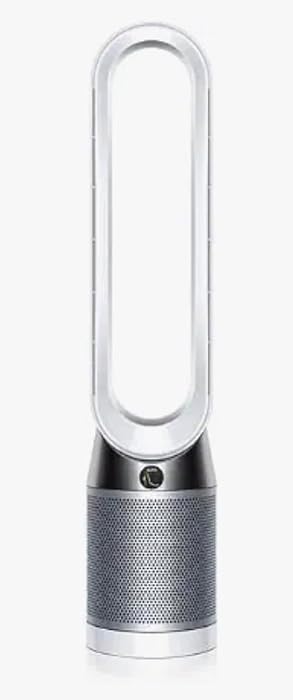
Affiliate link. Price and stock live at Amazon and change there, not on this page.
Dyson Purifier Big+Quiet Formaldehyde BP03

Affiliate link. Price and stock live at Amazon and change there, not on this page.
Dyson Purifier Hot+Cool HP1

Affiliate link. Price and stock live at Amazon and change there, not on this page.
Dyson Purifier Hot+Cool HP07 Air Purifier

Affiliate link. Price and stock live at Amazon and change there, not on this page.
Dyson Purifier Cool PC2 De-NOx

Affiliate link. Price and stock live at Amazon and change there, not on this page.
What Sets These Models Apart
While all 6 models share Dyson’s core Air Multiplier engineering and rigorous HEPA-grade particle capture, their practical utility differs significantly across seasonal heating, chemical filtration layers, and digital connectivity. The table below outlines how these models compare across their core technical capabilities.
| Model | Primary Function | Filtration Level | Smart Connectivity | Airflow & Oscillation |
|---|---|---|---|---|
| Dyson Purifier Cool Gen1 TP10 | Purifying Fan (Cooling) | Sealed HEPA Standard | Remote Control Only (No App) | Air Multiplier, Up to 350° |
| Dyson Pure Cool Purifier Fan TP4A | Purifying Fan with Backward Mode | 360° Glass HEPA & Activated Carbon | Remote Control with Sensor Feedback | Over 77 gal/s (1757 cfm), 45° to 350° |
| Dyson Purifier Big+Quiet Formaldehyde BP03 | Heavy-Duty Large-Room Purifier | 360° HEPA H13, Carbon & Catalytic Formaldehyde | Listing does not specify app support | Cone Aerodynamics (32+ ft Projection) |
| Dyson Purifier Hot+Cool HP1 | Purifying Heater & Fan | Whole-Machine HEPA H13 & Carbon | MyDyson App & Voice Services | Over 76 gal/s, Up to 350° |
| Dyson Purifier Hot+Cool HP07 Air Purifier | Purifying Heater, Fan & Backward Mode | Whole-Machine HEPA H13 & Carbon | MyDyson App, Voice & LCD Screen | Air Multiplier, Up to 350° |
| Dyson Purifier Cool PC2 De-NOx | Purifying Fan with De-NOx & Formaldehyde | 3-Stage HEPA H13, De-NOx Carbon & Catalytic | MyDyson App & Voice Services | Over 76 gal/s, Up to 350° |
Figures in this table are copied from the Amazon listings for these models.
Buying Tips for Dyson HEPA Air Purifiers
When selecting between these Dyson models, the primary architectural decision is deciding between a dedicated cooling tower and a Hot+Cool multi-season appliance. Dedicated cooling models like the Gen1 TP10, TP4A, and PC2 De-NOx stand over 41 inches tall, making them optimal for distributing high volumes of refreshing air across living rooms and bedrooms during warm months. However, if your home experiences drafty winters and you want to avoid storing a secondary space heater, compact 30-inch units like the HP1 and HP07 deliver ceramic warmth and air purification through a single electrical outlet.
Understanding Dyson’s sealing standards is equally essential when evaluating air cleaners. Many conventional air cleaners only certify the flat filter material itself, leaving small gaps around the frame where untreated air escapes back into the room. Dyson models carrying the HEPA H13 designation—including the BP03, HP1, HP07, and PC2 De-NOx—are tested to ensure that the entire machine enclosure remains completely sealed. If anyone in your household manages severe seasonal allergies, asthma, or pet dander sensitivities, investing in whole-machine HEPA H13 containment provides maximum filtration integrity.
Finally, consider the specific chemical pollutants present in your immediate neighborhood. Standard activated carbon filters successfully absorb common organic odors like food smells and pet musk. However, if you are moving into newly constructed housing with fresh paint and engineered wood flooring, a model with permanent catalytic formaldehyde destruction such as the BP03 or PC2 De-NOx prevents off-gassing accumulation. Similarly, if your home is positioned close to heavy highway traffic or uses unvented gas cooktops, the PC2 De-NOx provides dedicated capture media for harmful nitrogen dioxide fumes.
FAQ
How does whole-machine HEPA H13 sealing differ from standard HEPA filtration?
Standard HEPA ratings traditionally measure the efficiency of the pleated filter media alone under controlled airflow tests. In practice, unsealed purifier casings frequently allow fine dust, soot, and allergens to leak around the filter edges and escape through housing seams. Whole-machine HEPA H13 sealing guarantees that the entire purifier body, including filter gaskets and motor housings, meets the 99.97% containment threshold for particles down to 0.3 microns, preventing bypass leaks completely.
What is the difference between Dyson Purifier Cool and Hot+Cool models?
The fundamental difference lies in the integration of ceramic thermal heating elements. Dyson Purifier Cool models function exclusively as air purifiers and oscillating circulation fans that deliver cooling personal airflow during warm weather. In contrast, Hot+Cool models incorporate fast-acting ceramic PTC plates inside the airflow amplifier loop, allowing the unit to serve as an electric room heater in winter while continuing to purify your indoor air year-round.
Does the catalytic formaldehyde filter ever need to be replaced?
No, the catalytic formaldehyde filter found on machines like the Dyson Purifier Big+Quiet BP03 and Dyson Purifier Cool PC2 De-NOx is engineered to last for the life of the machine. Rather than absorbing formaldehyde inside microscopic pores like conventional carbon, the catalytic matrix uses a chemical reaction to continuously break formaldehyde molecules down into harmless water and carbon dioxide, allowing the filter to regenerate itself indefinitely.
Can Dyson purifiers operate without connecting to the MyDyson app?
Yes, all Dyson purifiers can be operated manually without smartphone applications. The Dyson Purifier Cool Gen1 TP10 does not have app capabilities and relies strictly on its included curved, magnetized remote control. Connected models such as the HP1, HP07, and PC2 De-NOx also ship with dedicated physical remote controls that provide complete access to oscillation settings, fan speeds, heating temperatures, and sleep timers right out of the box.
What is the benefit of backward airflow mode on Dyson purifiers?
Backward airflow mode redirects the purified airflow out through a secondary channel along the rear edge of the amplifier loop instead of blowing it forward. This feature allows the machine to maintain its full air cleaning and particle filtration capacity during cold weather without projecting a direct cooling fan breeze toward people sitting in the room.


