Which Creality Resin 3D Printer Should You Actually Buy?
5 models comparedSeptember 22, 202610 min read
Specs below are quoted from each Amazon listing. Scores are the average rating Amazon buyers left. Nothing on this page was handled or measured by us.
As Amazon Associates, we earn from qualifying purchases. This means we may receive a small commission at no extra cost to you if you click through and make a purchase.
Choosing the right creality resin 3d printer requires balancing resolution, build volume, and the post-processing demands of photopolymer printing. Creality’s Halot series resin printers span from compact desktop units tailored for detailed gaming figurines to high-speed, large-format machines designed for rapid prototyping and jewelry fabrication. Navigating specifications like 16K, 14K, and 9K LCDs can be confusing without understanding how pixel pitch and physical screen area interact during actual printing.
This guide breaks down 5 essential Creality products that form a complete resin workflow. We examine three core printing machines—the flagship Halot-X1 Combo, the entry-friendly HALOT-X1 Neo, and the high-speed Halot Mage—alongside two indispensable studio accessories: the UW-03 wash and cure station and the official heavy-duty enclosure. Through this creality resin printer comparison, you will discover which creality resin printer to buy to match your workspace, technical goals, and detail requirements.
Which Creality Resin 3D Printer Should You Buy
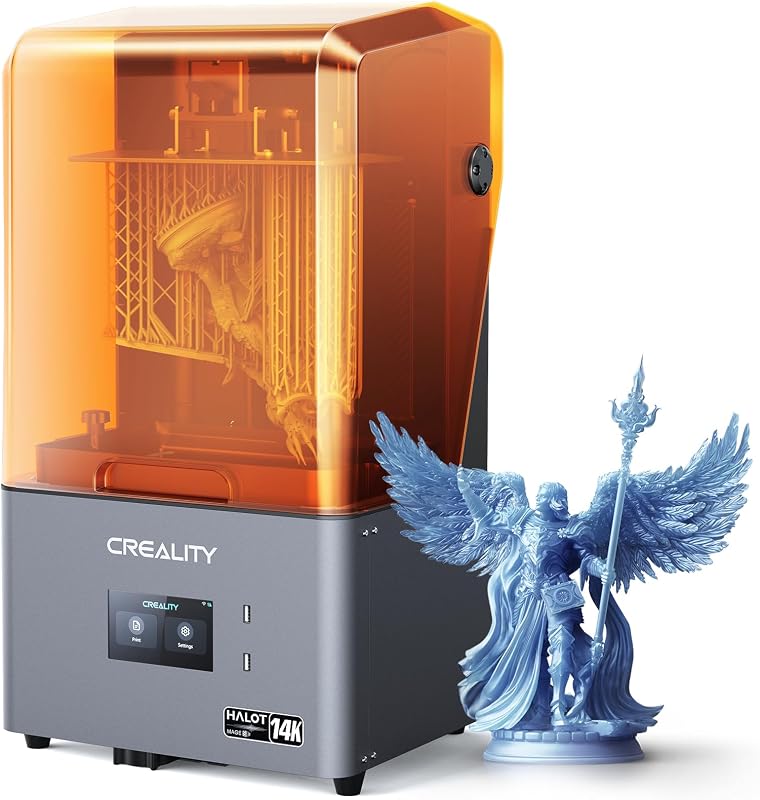
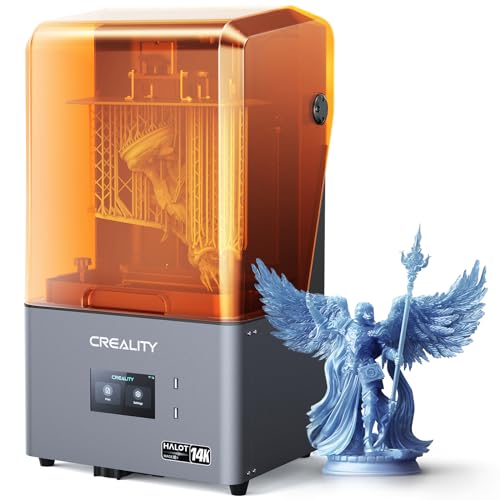
Creality Resin 3D Printer Halot Mage
Best for: Hobbyists producing large models at blazing speeds
Pros
Dynax+ mode speeds reaching 150 mm/h
Spacious 10.1-inch 14K monochrome screen
Built-in activated carbon air filter
Cons
Listing does not include automated resin heating
Bulky 12.5-kilogram aluminum chassis
Creality Halot-X1 Combo Resin 3D Printer: Best for advanced creators needing 16K resolution, automated resin heating, and stable top-down optical movement. see 1 of 5
Creality HALOT-X1 Neo Resin 3D Printer: Best creality resin 3d printer for beginners seeking factory pre-leveling, sharp 9K resolution, and AI model generation. see 2 of 5
Creality Resin 3D Printer Halot Mage: Best for creators needing large 10.1-inch 14K build capacity combined with Dynax+ high-speed printing. see 3 of 5
Creality Wash and Cure Station UW-03: Best for streamlining post-processing with high-powered vortex agitation and 405nm ultraviolet curing. see 4 of 5
Creality Official Resin 3D Printer Enclosure: Best for workshops needing thermal insulation, external vapor venting, and comprehensive dust protection. see 5 of 5
Affiliate link. Price and stock live at Amazon and change there, not on this page.
Best for Design professionals needing ultra-fine 16K prototyping precision
Pros
16K mono LCD with 14×19 micrometer accuracy
AFU system with 3-minute rapid resin heating
Fixed build plate with top-down moving optics
Cons
Heavy 38-pound desktop footprint
Complex advanced features for complete novices
The Creality Halot-X1 Combo Resin 3D Printer represents the pinnacle of Creality’s engineering in the photopolymer space, targeting users who demand uncompromising surface precision. Anchored by a 10.1-inch 16K monochrome LCD producing 15120×6230 resolution, it delivers an extraordinary 14×19 micrometer pixel pitch. This microscopic fidelity eliminates stair-stepping layer lines on complex geometry, rendering smooth organic curves on display models. With a generous 211.68 x 118.37 x 200 mm build volume and print speeds reaching up to 170 mm/h, it balances high-resolution output with fast turnaround times.
Intelligent material handling is the core differentiator here. The AFU Resin Management System incorporates internal heating to bring liquid resin from 30 to 45 degrees Celsius in three minutes, thinning viscosity to ensure dependable layer adhesion. Automated laser liquid detection manages resin levels, while RFID recognition reads material containers directly. Mechanics are equally advanced: the build plate remains stationary while the resin vat and optical module move vertically along dual linear rails and dual lead screws. For makers transitioning from multi-material FDM tools like bambu lab 3d printers, this inverted motion system delivers superior mechanical stability.
10.1-inch 16K monochrome LCD with 15120×6230 resolution and 14×19 micrometer pixel size.
AFU resin management featuring 3-minute rapid heating, RFID profile reading, and laser level feeding.
Top-down optical movement with a fixed build plate supported by dual linear rails and dual lead screws.
92 independent light zones for dynamic UV exposure and extended screen longevity.
Affiliate link. Price and stock live at Amazon and change there, not on this page.
Best for Beginners printing detailed tabletop miniatures and figures
Pros
Factory pre-leveled platform for plug-and-play setup
Sharp 9K LCD with 18-micrometer pixel size
FanForge AI converts 2D images to 3D models
Cons
Compact 153x77x160 mm maximum build volume
Manual resin temperature monitoring required
For hobbyists stepping into photopolymer printing, the Creality HALOT-X1 Neo Resin 3D Printer eliminates initial friction. Fitted with a 6.8-inch 9K monochrome LCD boasting 8520×4320 resolution, the Neo achieves an ultra-fine 18-micrometer XY pixel pitch. This high pixel density makes it an exceptional creality resin printer for miniatures, tabletop gaming figures, and intricate character sculpts where facial features, fine chainmail, and crisp armor filigree must stand out sharply under paint.
Accessibility is the main focus of this desktop unit. The build platform arrives factory pre-leveled, allowing you to unbox the machine, tighten the platform, pour resin, and start printing immediately without paper shims or manual leveling bolts. Novices can scan an on-chassis QR code to access Creality Wiki tutorials covering essential safety and slicing steps. Additionally, integrated FanForge AI converts 2D reference images into printable 3D assets in as fast as 3.5 hours. For enthusiasts comparing entry-level alternatives like elegoo 3d printers, the Neo provides robust Wi-Fi, USB, and Creality Cloud file transfers alongside broad Lychee and CHITUBOX compatibility.
6.8-inch 9K monochrome LCD with 8520×4320 resolution and 18-micrometer XY pixel size.
Factory pre-leveled build platform for immediate out-of-the-box printing success.
FanForge AI system for converting flat 2D image prompts into 3D printable files.
Compact 153.36 x 77.76 x 160 mm build envelope with layer thicknesses down to 0.01 mm.
Affiliate link. Price and stock live at Amazon and change there, not on this page.
Bridging mid-format versatility and rapid throughput, the Creality Resin 3D Printer Halot Mage (specifically the Halot-Mage S edition) is built for serious batch production. Featuring a 10.1-inch 14K monochrome screen with 13320×5120 resolution and a 16.8×24.8 micrometer pixel pitch, it offers a spacious print area suitable for multiple miniatures or large mechanical prototypes. Creality incorporates its Integral Light Source 3.0, delivering uniform ultraviolet energy across the entire build zone for consistent edge sharpness.
Speed is the standout capability of the Halot Mage. Equipped with a closed-loop motor and dual linear rails, its Dynax+ high-speed mode pushes vertical print speed up to 150 mm/h, enabling you to produce a 15-centimeter tall model in roughly one hour. To prevent failures during aggressive lifting, it utilizes a laser-carved build plate for strong layer adhesion and a three-layer Pictor speed-release film that reduces vat peel force by 35 percent. An activated carbon air filter actively scrubs chemical odors from your workshop, and the printer includes a complimentary three-month CHITUBOX Pro membership.
Affiliate link. Price and stock live at Amazon and change there, not on this page.
Best for Makers seeking mess-free washing and UV curing
Pros
Powerful 500 RPM vortex cleaning impeller
Spacious 6.72L wash and 10.64L cure volume
Square anti-roll turntable with protective curb
Cons
Consumes significant dedicated countertop area
Requires large volumes of solvent
Removing a freshly printed model from the build plate is only half the process; raw photopolymer prints remain tacky and brittle until cleaned and post-cured. The Creality Wash and Cure Station UW-03 combines chemical washing and secondary ultraviolet curing into a single desktop unit. A 500 RPM magnetic propeller generates a 31 percent stronger solvent vortex, driving isopropyl alcohol through recessed miniature crevices to dissolve uncured resin without manual scrubbing.
The UW-03 offers significant capacity, featuring a 6.72-liter wash container (210 x 160 x 200 mm) and a 10.64-liter curing chamber. It introduces a space-efficient square turntable with a perimeter lip, preventing rounded models from rolling off during rotation. For mess-free operation, the station supports hang-state washing, allowing you to mount build plates between 8.9 and 10.3 inches directly into the solvent tank without removing wet models. The orange acrylic hood blocks 99.9 percent of 405nm UV light and features an automatic safety shutoff that halts curing if opened.
Dual washing and curing station powered by a 500 RPM magnetic vortex propeller.
Generous volume with a 6.72-liter wash container and a 10.64-liter UV curing capacity.
Square anti-roll turntable designed to maximize space and secure circular models.
Direct hang-state washing compatible with build plates from 8.9 to 10.3 inches.
Affiliate link. Price and stock live at Amazon and change there, not on this page.
Best for Home workshops needing thermal stability and fume control
Pros
Massive interior fits printer and wash station
Flame-retardant aluminum foil cloth material
Fan interface for negative pressure exhaust ducting
Cons
Large 39-inch square footprint requires deep desks
Requires assembly of metal framework
Managing ambient air quality and temperature is essential for consistent resin printing, making the Creality Official Resin 3D Printer Enclosure a practical addition to any workspace. With expansive dimensions measuring 1000 x 500 x 1000 mm (roughly 39.37 inches per side), this tent provides ample room to house a resin 3D printer alongside the UW-03 wash and cure station inside a single protective barrier. Containing your entire chemical workflow helps prevent accidental resin spills from damaging furniture.
Beyond cleanliness, the enclosure provides thermal stability. Resins suffer adhesion failures and layer delamination when ambient room temperatures drop below recommended levels. The tent retains radiant heat from internal motors and light sources, creating an insulated microclimate for dependable curing while buffering operational noise. Constructed from flame-retardant aluminum foil fabric over a rigid metal frame, it protects against dust and fire hazards. A transparent viewing window lets you monitor print layers, and a built-in fan interface allows connection of an exhaust hose to direct chemical odors outside.
Massive 1000 x 500 x 1000 mm interior capable of holding both a printer and a wash/cure unit.
Flame-retardant aluminum foil cloth over a sturdy structural metal skeleton.
Integrated fan exhaust port for venting chemical fumes directly out of the room.
Large transparent front window for easy visual monitoring without releasing heat.
What Sets These Models Apart
Understanding the differences across Creality’s lineup helps you match the right machine to your intended projects. The table below outlines how the three printers and two workshop accessories compare across resolution, physical dimensions, build volume, and primary design roles.
Model
Resolution / Function
Work Envelope
Primary Advantage
Halot-X1 Combo
16K Mono LCD (14×19 μm)
211.68 × 118.37 × 200 mm
AFU resin heating, top-down optics, 92 light zones
HALOT-X1 Neo
9K Mono LCD (18 μm)
153.36 × 77.76 × 160 mm
Factory pre-leveled build plate, AI modeling engine
Halot Mage
14K Mono LCD (16.8×24.8 μm)
10.1-inch screen area
Dynax+ 150 mm/h speed, carbon filtration, Chitubox Pro
Flame-retardant cloth, fan vent port, dual-machine fit
Figures in this table are copied from the Amazon listings for these models.
Buying Tips for Creality Resin 3D Printers
When weighing a creality 16K vs 14K vs 9K resin printer, pixel density matters far more than just resolution labels. A 9K resolution on a compact 6.8-inch screen like the HALOT-X1 Neo yields an 18-micrometer pixel pitch, providing comparable surface smoothness to a 14K or 16K panel stretched across a 10.1-inch screen. If your primary focus is tabletop miniatures or fine jewelry where fine surface fidelity is critical, high pixel density on a smaller screen offers outstanding quality. For creators printing larger structural parts or batching dozens of miniatures simultaneously, the expansive build area of a 10.1-inch machine saves valuable time.
Ambient workspace temperature is another vital consideration when choosing your equipment. Photopolymer resins require steady temperatures between 25 and 30 degrees Celsius to achieve reliable layer adhesion and maintain low viscosity. If your printing setup resides in an unheated garage or drafty basement, automated resin heating on the Halot-X1 Combo eliminates cold-temperature failures entirely. Alternatively, placing your printer inside a protective thermal enclosure traps residual heat from the internal electronics, stabilizing the vat temperature without requiring dedicated vat heaters.
Finally, plan for the full post-processing workflow rather than treating the 3D printer as a standalone device. Liquid resin prints emerge from the vat coated in sticky uncured resin and require washing in alcohol followed by 405nm ultraviolet curing to reach full hardness. Incorporating an all-in-one station like the UW-03 streamlines cleaning, eliminates messy sinks, and ensures models cure evenly without surface distortion or brittleness.
FAQ
What is the difference between Creality 16K, 14K, and 9K resin printers?
The difference lies in pixel resolution and screen dimensions, which determine XY pixel pitch and total print area. The Halot-X1 Combo uses a 10.1-inch 16K screen for 14×19 micrometer precision, the Halot Mage uses a 10.1-inch 14K screen (16.8×24.8 micrometers) for high-speed batch production, and the HALOT-X1 Neo uses a 6.8-inch 9K screen to deliver sharp 18-micrometer detail on a compact desktop footprint.
Which Creality resin printer is best for beginners?
The Creality HALOT-X1 Neo is the best choice for beginners due to its factory pre-leveled build platform, which removes common calibration hurdles. It features an onboard QR code for quick tutorial access, FanForge AI for simplified 2D-to-3D asset creation, and standard Wi-Fi connectivity compatible with HALOT BOX, CHITUBOX, and Lychee Slicer.
Do I really need a wash and cure station for resin 3D printing?
While you can clean prints manually in plastic tubs and cure them in sunlight, a wash and cure station like the Creality UW-03 makes the process significantly cleaner, faster, and safer. Its magnetic vortex removes stubborn resin residues from deep recesses, and dedicated 405nm UV LEDs fully harden prints uniformly to prevent warping or incomplete polymerization.
Can the Creality resin 3D printer enclosure hold both a printer and a wash station?
Yes. Measuring 1000 x 500 x 1000 mm, the Creality Official Resin 3D Printer Enclosure is designed with extra-large interior volume specifically to house both a standard or mid-size resin 3D printer and a washing and curing station side by side.
Why is resin heating helpful on the Halot-X1 Combo?
Resin viscosity increases when cold, causing poor layer adhesion, higher vat peel forces, and failed prints. The Intelligent AFU system on the Halot-X1 Combo heats resin from 30 to 45 degrees Celsius in three minutes, ensuring consistent material flow and significantly increasing print success rates in cool rooms.