Anker Electric Generators: Which SOLIX Power Station Fits Your Setup?
Specs below are quoted from each Amazon listing. Scores are out of 10, based on listed specifications and buyer feedback. Nothing on this page was handled or measured by us.
As Amazon Associates, we earn from qualifying purchases. This means we may receive a small commission at no extra cost to you if you click through and make a purchase.
Finding the right electric generator anker builds comes down to matching storage capacity and continuous power delivery to your everyday electrical demands. Whether preparing your household for severe weather blackouts, organizing gear for an off-grid camping weekend, or keeping heavy work tools energized at a remote job site, selecting a dedicated anker electric generator removes the noxious fumes, flammable fuel cans, and persistent engine noise of conventional combustion machinery. Modern battery stations capture incoming utility grid or solar power within resilient lithium iron phosphate chemistry, supplying clean, surge-protected electricity suitable for sensitive laptops, smart mobile devices, and demanding residential appliances alike.
This Anker generator comparison examines three distinct models from the manufacturer’s lineup: the original Anker SOLIX C1000 Portable Power Station, the upgraded Anker SOLIX C1000 Gen 2 Portable solar bundle, and the high-capacity Anker SOLIX F3800 Portable Power Station. While the C1000 configurations emphasize rapid wall recharging, compact chassis dimensions, and grab-and-go portability for outdoor travel, the stationary F3800 steps up to true split-phase 120V and 240V output alongside direct vehicle integration. Evaluating these power stations across continuous running wattage, modular battery expansion, outlet arrays, and solar replenishment speeds will help you determine which Anker generator to buy for your specific home or travel setup.
Which Anker Electric Generators Should You Buy
- Weekend campers, road trippers, and tailgaters who need rapid AC wall replenishment and versatile outlet connectivity: Anker SOLIX C1000 Portable Power Station.
see 1 of 3 - Off-grid travelers and remote professionals requiring bundled solar harvesting, higher continuous wattage, and sub-10ms UPS protection: Anker SOLIX C1000 Gen 2 Portable.
see 2 of 3 - Homeowners needing multi-day residential backup, split-phase 240V appliance power, and direct recreational vehicle or EV charging: Anker SOLIX F3800 Portable Power Station.
see 3 of 3
Anker SOLIX C1000 Portable Power Station

Affiliate link. Price and stock live at Amazon and change there, not on this page.

Best for
Off-grid travelers wanting bundled solar power
Pros
- Includes 200W bifacial solar panel
- Upgraded 2,000W output with 3,000W surge
- Fast sub-10ms UPS switchover
Cons
- Dispatched across two separate packages
Best for
Weekend campers needing ultra-fast wall recharging
Pros
- Recharges to 80 percent in 43 minutes
- 1800W continuous output with 2400W SurgePad
- 11 versatile output ports
Cons
- Solar panel sold separately
The Anker SOLIX C1000 Portable Power Station functions as an agile power reservoir built to handle vehicle excursions, campsite utility, and sudden domestic outages. At the core of the machine sits a 1,056Wh lithium iron phosphate (LiFePO4) battery designed to endure regular cycling without rapid degradation. The inverter supplies 1800W of continuous output wattage, backed by Anker’s integrated SurgePad technology that pushes heating and motor capabilities up to 2400W so high-draw resistive items like skillets and hot plates operate without tripping internal breakers. Rather than managing the fuel storage, pull cords, and exhaust required by a traditional engine like a champion 3100 watt inverter generator, this silent system safely provides indoor and in-tent electricity at a standard 230V alternating current rating.
Rapid energy recovery distinguishes this base unit from bulkier alternatives. Utilizing UltraFast AC wall recharging, the battery recovers from zero to 80 percent charge in 43 minutes when plugged into a domestic socket, achieving a full 100 percent replenishment in under an hour within its 68 to 122 degree Fahrenheit operational temperature window. For off-grid adventures, the built-in solar controller accepts up to 600W of solar input, returning the cells to full charge in roughly 1.8 hours under clear sunlight. Distributing this energy is straightforward thanks to 11 total power outlets that run CPAP machines, mini-fridges, mobile gear, and camping lights simultaneously. Users can also tailor charging rates and observe power flow metrics remotely through Wi-Fi or Bluetooth using the Anker companion smartphone app.
Long-term investment value is anchored by the unit’s internal LiFePO4 cells, which maintain operational integrity across 3,000 charge cycles for a rated 10-year service life. Because the outer enclosure is engineered to be roughly 15 percent smaller than standard 1kWh units, it stows easily in crowded vehicle trunks or utility closets. In the box, Anker provides the portable power station, an AC charging cable, a 12V car charging cable, and an instructional user guide. While its 1,056Wh storage is well-suited for overnight trips and mobile routines, users wanting built-in solar panels right out of the box or multi-kilowatt home backup will prefer the other models in the lineup.
- 1,056Wh LiFePO4 battery providing 3,000 cycles across a rated 10-year operating lifespan.
- 1800W continuous output with 2400W SurgePad capability distributed across 11 power outlets.
- UltraFast AC recharging reaching 80 percent in 43 minutes and a full recharge in under an hour.
- Accepts up to 600W fast solar input for complete off-grid recharging in 1.8 hours.
Anker SOLIX C1000 Gen 2 Portable
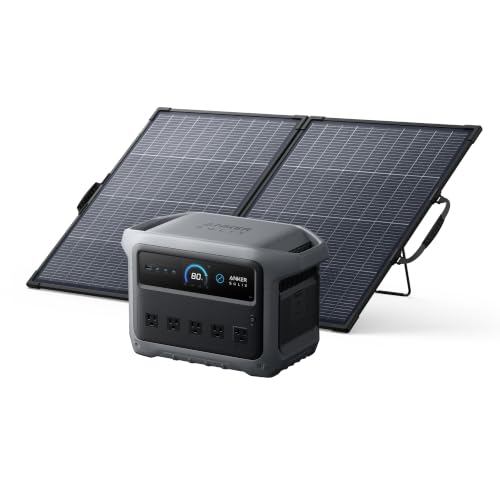
Affiliate link. Price and stock live at Amazon and change there, not on this page.
Anker SOLIX F3800 Portable Power Station

Affiliate link. Price and stock live at Amazon and change there, not on this page.
What Sets These Models Apart
Understanding the architectural differences between these battery stations clarifies which system matches your electrical goals. While all three share Anker’s durable lithium iron phosphate battery foundations and smart mobile application controls, their running capacities, continuous output ceilings, and port layouts are engineered for vastly different environments. The C1000 models target travel agility, vehicle storage, and rapid top-ups, whereas the F3800 provides stationary household power distribution.
| Model | Battery Capacity | Continuous Output | Total Power Outlets | Primary Application |
|---|---|---|---|---|
| Anker SOLIX C1000 Portable Power Station | 1,056Wh | 1800W (2400W SurgePad) | 11 | Campsite power, road trips, light storm backup |
| Anker SOLIX C1000 Gen 2 Portable | 1,024Wh | 2,000W (3,000W peak) | 9 | Off-grid solar camping, sensitive electronics UPS |
| Anker SOLIX F3800 Portable Power Station | 3,840Wh (expandable) | 6,000W (expandable) | 3 | Whole-home backup, heavy RV hookups, EV charging |
As outlined in the comparison table, jumping from the C1000 generation up to the F3800 represents a massive tripling of base storage capacity and a threefold increase in continuous running wattage. The C1000 variations distribute electricity across numerous smaller AC and DC ports suited for mobile electronics, kitchen accessories, and CPAP equipment. In contrast, the F3800 concentrates its immense output into high-amperage 120V/240V receptacles designed to run an entire household or an off-grid recreational vehicle without requiring separate voltage converters.
Figures in this table are copied from the Amazon listings for these models.
Buying Tips for Anker Electric Generators
When selecting the best Anker electric generator for your home or recreational setup, calculate your continuous running wattage alongside initial starting surges. Refrigerators, air conditioners, and power tools draw a brief surge of wattage when their compressors or motors engage, which can trip under-sized inverters. If your primary goal is keeping lights, food cold, and laptops running during weekend storms, an energy bank between 1,000Wh and 2,000Wh delivers dependable performance without taking up excessive storage space. However, if your daily routine involves running 240V appliances like clothes dryers, well pumps, or electric vehicle charging, choosing a dual-voltage platform like the F3800 is essential.
Solar replenishment logistics should also guide your selection. Both the original C1000 and the Gen 2 platform accept up to 600W of solar input, returning empty cells to full charge in roughly 1.8 hours under clear sunlight. If you camp frequently in remote areas away from commercial grid hookups, choosing the Gen 2 model with its bundled 200W bifacial solar panel guarantees an immediate solar harvesting solution without needing to purchase separate solar panels. Ensure that any panel configuration matches the station’s maximum voltage parameters to maintain optimal charging efficiency in varying weather conditions.
Finally, factor in long-term cycle durability and emergency switchover capabilities. Modern Anker power stations utilize resilient lithium iron phosphate (LiFePO4/LFP) battery chemistry, which delivers between 3,000 and 4,000 full charge cycles before dropping to 80 percent of original capacity. For domestic home office use or critical medical CPAP operation, prioritize units featuring automatic UPS switchover speeds under 10 milliseconds. This rapid transition prevents equipment resets during utility drops, providing seamless protection for your sensitive hardware.
FAQ
Can an Anker electric generator run a full-sized household refrigerator?
Yes, all three Anker models featured here can easily power a standard household refrigerator. Modern refrigerators generally draw between 100W and 300W while running, with brief starting surges reaching up to 1200W. The C1000 models supply at least 1800W of continuous output, easily accommodating these startup spikes, while the F3800 can run a family refrigerator for several days on its internal 3.84kWh capacity.
What is the benefit of LiFePO4 battery chemistry in Anker power stations?
Lithium iron phosphate (LiFePO4 or LFP) battery chemistry offers superior thermal stability, safety, and longevity compared to traditional lithium-ion formulations. These cells resist overheating and provide between 3,000 and 4,000 complete charge cycles before experiencing noticeable capacity reduction, delivering roughly a decade of regular use.
How fast does an Anker solar generator recharge using sunlight?
Recharging speed depends entirely on available solar wattage and environmental conditions. Both the C1000 and C1000 Gen 2 support up to 600W of fast solar input, allowing them to recharge fully in roughly 1.8 hours under optimal direct sunlight. Actual recharge durations will vary based on panel orientation, seasonal daylight intensity, and cloud cover.
Can the Anker SOLIX F3800 charge an electric vehicle directly?
Yes, the Anker SOLIX F3800 features an integrated NEMA 14-50 outlet capable of supplying 6,000W of power directly to an electric car. You can connect your standard EV charging cable straight into the power station without purchasing specialized grounding adapters, delivering emergency driving range during extended power outages.
What does Anker SurgePad technology do on the C1000 models?
SurgePad technology allows the inverter to power resistive heating and motor appliances with wattages that exceed the continuous 1800W rating, handling loads up to 2400W. Instead of shutting down the station when a high-draw appliance like an electric kettle or space heater is connected, SurgePad lowers the voltage slightly to keep the appliance running smoothly.


