Anker’s 140W-and-Up USB-C Cables Compared: Which One Should You Get?
Specs below are quoted from each Amazon listing. Scores are out of 10, based on listed specifications and buyer feedback. Nothing on this page was handled or measured by us.
As Amazon Associates, we earn from qualifying purchases. This means we may receive a small commission at no extra cost to you if you click through and make a purchase.
When shopping for an anker 140w usb c cable, the primary goal is delivering full-speed Power Delivery to demanding laptops like modern MacBooks without overheating, power throttling, or premature cable failure. Fast charging at 140 watts or above requires hardware built to handle high electrical throughput safely, yet shoppers often face confusion when comparing cables that advertise identical wattage thresholds or step up to 240 watts. Whether you need an anker usb c cable 140w macbook pro setup to charge your workstation from a wall brick or a versatile cord for daily commuting, picking the right cable comes down to how practical the build is for your daily routine.
In this detailed anker usb c cable comparison, we evaluate four high-output charging cables engineered by Anker: a dual-output 140W splitting cord, an ultra-resilient 240W flagship cable, a heavy-duty straight 240W two-pack, and an ergonomic 90-degree right-angle 240W two-pack. While all four cords handle high-wattage charging, they differ significantly in connector geometry, physical length, split-cable convenience, bend test longevity, and packaging value. Deciding which anker usb c cable to buy depends on whether you value split charging on the go, extreme physical resilience, multi-pack convenience for multiple workstations, or a low-profile angled plug for tight spaces.
Which Anker USB-C Cables Should You Buy
- Travelers who need to charge a laptop and a phone simultaneously from a single charger port should choose the Anker 2-in-1 USB C to USB.
see 1 of 4 - Heavy-duty users demanding the highest physical durability, extreme temperature resistance, and an everlasting warranty should pick the Anker Prime USB C to USB.
see 2 of 4 - Everyday workstation users looking for reliable 240W charging and a backup cable in a double pack should select the standard Anker USB C to USB C.
see 3 of 4 - Mobile gamers, bedside phone users, and tight desk setups requiring a flush connection should choose the right-angle Anker USB C to USB C.
see 3 of 4
Anker 2-in-1 USB C to USB

Affiliate link. Price and stock live at Amazon and change there, not on this page.
Anker Prime USB C to USB

Affiliate link. Price and stock live at Amazon and change there, not on this page.
Anker USB C to USB C

Affiliate link. Price and stock live at Amazon and change there, not on this page.
Best for
Handheld mobile gaming and tight desk spaces
Pros
- Ergonomic 90-degree right-angle connector
- Two 6-foot braided cables included
- Full 240W high-speed charging
Cons
- Incompatible with cases over 3mm
- Does not support monitor video
Best for
Everyday desk and travel workstation backup
Pros
- Includes two 6-foot cables
- Full 240W power delivery support
- USB-IF certified safety compliance
Cons
- Basic 480 Mbps data transfer
- Straight plug strains in tight spaces
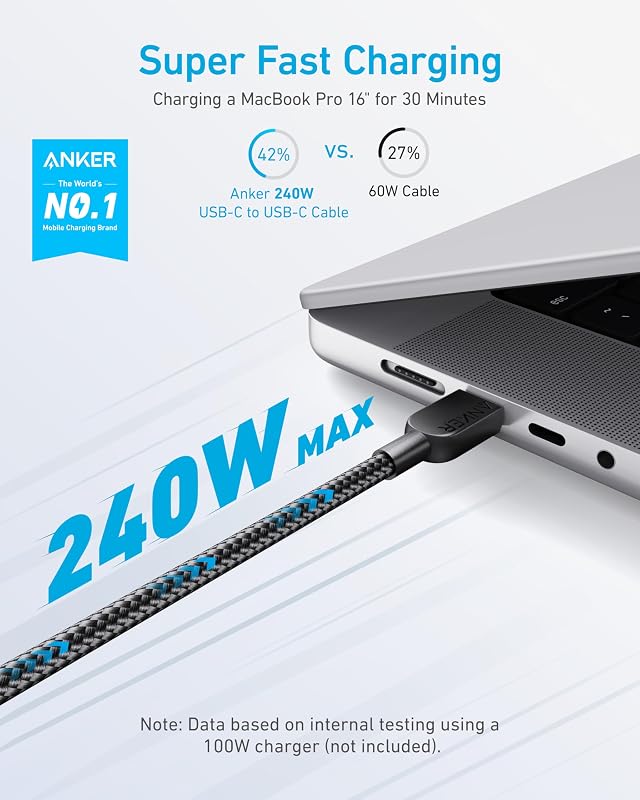
When you need reliable high-wattage charging across multiple workstations, this standard version of the Anker USB C to USB C offers a dependable dual-cable package. Designed as an anker 240w usb c cable bundle, each 6-foot cord can drive up to 240W of power delivery, taking a 16-inch MacBook Pro to 42% battery in 30 minutes. Supplying two identical cables in one box makes it easy to keep one stationary at a home desk while tossing the other into your daily commuter backpack.
Each anker braided usb c charging cable 6 ft lead in this pack utilizes unbreakable double braided nylon that delivers a 10,000-bend lifespan. The cable is officially USB-IF compliant, ensuring it adheres strictly to industry safety standards for high-capacity charging. Its technical specifications list 480 megabits per second data transfer speeds, a 24-pin design, and broad compatibility across hardware including iPad, Samsung Galaxy S23+, iPhone 15 Pro Max, and USB-C laptops. The listing also notes a 5V maximum voltage specification under its technical details.
This two-pack suits everyday shoppers who want standard straight connectors, generous 6-foot reach, and trusted high-wattage delivery without paying for specialized industrial temperature ratings. It gives way to the Prime cable if you subject your gear to aggressive daily twisting that requires hundreds of thousands of bends, and it gives way to the right-angle version if you charge handheld devices while using them. The package includes two 6 ft braided cables, a welcome guide, and a 24-month warranty.
- Convenient two-pack bundle providing two 6-foot charging cables
- High-capacity 240W charging output compatible with laptops, phones, and tablets
- Certified USB-IF compliance meeting standardized safety benchmarks
- Double-braided nylon jacket tested for a 10,000-bend lifespan
Anker USB C to USB C
The right-angle variant of the Anker USB C to USB C rethinks connector geometry for ergonomic comfort. Delivering full 240W power throughput, this anker usb c right-angle cable 240w package comes as a two-pack of 6-foot braided cords. In speed testing, it charges an iPhone 15 Pro to 57% or a 15-inch MacBook Air with M2 to 44% in just 30 minutes, providing uncompromised high-wattage performance despite its angled housing.
The primary benefit here is the 90-degree connector design, which directs the cable parallel to your device rather than sticking straight out. This profile reduces strain on the port and improves hand comfort during mobile gaming or video playback. The connector accommodates phone cases up to 3 mm thick, though the listing notes it is not recommended for heavy or bulky protective cases. The cable features a braided jacket exceeding 10,000 bends, a 20V maximum voltage rating, 480 Mbps data transfer speeds, 24 pins, and lists Cat 6 specifications. It supports broad compatibility across MacBooks, iPad Pro models, Galaxy S20 through S23 devices, ThinkPad X1 units, HP Spectre laptops, Pixel phones, and Fire HD 8 tablets.
This model is the ideal choice for handheld gamers, bedside browsing, car dashboard mounts, and tight desk spaces where a straight cable would bend sharply against a wall. It gives way to straight-plug models if your phone uses a thick, heavy-duty armored case, or if you prefer the dual-output split design of the 2-in-1 model. Anker supplies two 6 ft right-angle braided cables, a welcome guide, and a 24-month warranty in the package.
- Ergonomic 90-degree right-angle plug designed for comfortable handheld handling
- Full 240W high-speed charging suitable for demanding laptops and mobile devices
- Two-pack value with two durable 6-foot braided cables
- Exceeds 10,000 bends and fits slim phone cases up to 3 mm thick
What Sets These Models Apart
| Model | Wattage Rating | Length & Connector Form | Durability Rating | Package Contents & Warranty |
|---|---|---|---|---|
| Anker 2-in-1 USB C to USB | 140W Max | 4 ft (3 ft base + two 1 ft split leads), Straight | 10,000 bends | 1 cable, 18-month warranty |
| Anker Prime USB C to USB | 240W Max | 6 ft, Straight (Upcycled braid) | 300,000 bends | 1 cable + cord organizer, Everlasting warranty |
| Anker USB C to USB C | 240W Max | 6 ft, Straight (Double-braided nylon) | 10,000 bends | 2 cables, 24-month warranty |
| Anker USB C to USB C (Right-Angle) | 240W Max | 6 ft, 90° Right-Angle connector | 10,000+ bends | 2 cables, 24-month warranty |
Figures in this table are copied from the Amazon listings for these models.
Buying Tips for Anker USB-C Cables
Understanding the distinction between a 140w vs 240w usb c cable helps you avoid overthinking your purchase. USB Power Delivery operates on mutual negotiation: a 240W-rated cable will safely power a 140W MacBook Pro, a 65W ultrabook, or a 20W smartphone without forcing excess power into the battery. Choosing a 240W cable provides maximum headroom for future laptop upgrades, while a dedicated 140W cable is fully tailored to fast-charge high-draw machines like the 16-inch MacBook Pro at its top supported rate.
It is equally important to separate charging capabilities from data bandwidth. All four of these high-wattage Anker cords are engineered primarily for power transmission and operate on USB 2.0 architecture, capping data transfers at 480 megabits per second. They are perfect for delivering juice from wall adapters or an anker power bank laptop setup, but they are not intended for high-speed external SSD backups or connecting external display monitors.
Finally, factor in mechanical wear and physical form. An anker usb c cable durability bend test rating of 10,000 bends provides plenty of resilience for standard home and office use, but frequent travelers who coil cables tightly will appreciate the 300,000-bend rating of the Prime model. For handheld device usage or tight clearance behind nightstands, right-angle plugs significantly reduce mechanical leverage on your device’s charging port, provided your protective case does not exceed the 3 mm thickness threshold.
FAQ
Can an anker 140w usb c cable charge a MacBook Pro at full speed?
Yes. A 140W-rated Anker cable delivers the full wattage required to fast-charge compatible laptops like the 16-inch MacBook Pro, boosting the battery to 50% in roughly 20 to 26 minutes when paired with a matching 140W power adapter.
What is the difference between a 140w vs 240w usb c cable?
A 140W cable supports up to 28V at 5A under USB Power Delivery 3.1 specifications, whereas a 240W cable supports Extended Power Range up to 48V at 5A. Both charge 140W devices at identical speeds, but a 240W cable provides extra headroom for future hardware requiring higher wattage.
Do these high-wattage Anker cables support video output or display mirroring?
No. These models are engineered specifically for high-efficiency power delivery and standard USB 2.0 data transfers. They do not support DisplayPort alternate mode or screen mirroring to external USB-C monitors.
Why are these fast-charging cables limited to 480 Mbps data speeds?
Cables optimized for extreme charging wattage and physical flexibility prioritize robust copper power conductors and heavy shielding over high-frequency video wiring. The 480 Mbps USB 2.0 speed handles routine file transfers and syncing while keeping the cable flexible and durable.
Will the right-angle cable fit phones with protective cases?
The right-angle plug fits standard smartphone cases up to 3 mm thick. However, heavy-duty armored cases with thick rubber port bezels or integrated dust flaps may obstruct the angled connector from seating completely.